Product Description
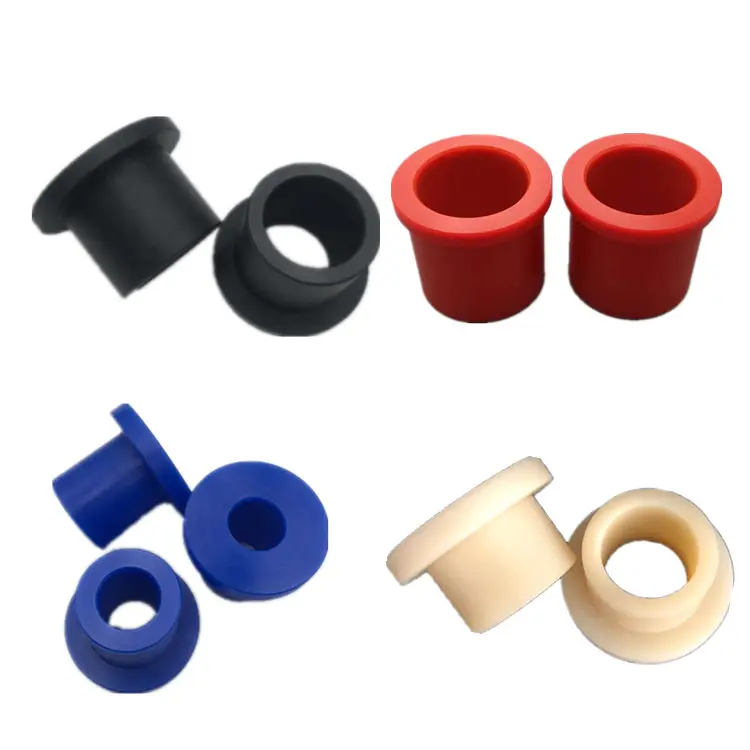
Engineering plastic Nylon6 Bushing
Mc nylon, means monomer casting nylon, is a kind of engineering plastics used in comprehensive industries, has been applied almost every industrial field.
The caprolactam monomer is first melted, and added catalyst, then poured it inside moulds at atmosphere pressure so as to shape in different castings, such as: Rod, plate, tube. The molecule weight of mc nylon can reach 70, 000-100, 000/mol, 3 times than pa6/pa66. Its mechanical properties are much higher than other nylon materials, such as: Pa6/pa66. Mc nylon plays a more and more important role in the material list recommended by our country.
Since the end of 1980’s, HangZhou engineering plastics industireis company has devoting herself on developing the technology of mc nylon modification, greatly extended the applications in different industries. Basing on the mc nylon, reinforced with variety of additives during the reaction, such as lubricant, molybdenum disulfide, graphite glass fiber, carbon fiber etc, to improve the properties, higher performance of wear-resistance, corrosion-resistance, self-lubrication, vibration-absorption, noise-absorption. At the same time, as the technics and structure of the moulds is quite simple, so that it can be manufactured in lower cost, becomes the ideal substitutes of bronze, stainless steel, babbitt alloy, ptfe and so on.
Oil nylon (green)
Oil nylon(green)is the new engineering plastics that developed by HangZhou engineering plastics industireis company in the later 1980’s by importing the advanced technology from nylacast co., ltd, uk, was the first authentic lubricating nylon that builds the liquid lubricant system during the processing stage, which makes its coefficient of friction is 50% lower than the general pa6 or pa66, the wear-resistance is 10 times than the general ones. Oil nylon is specially developed for the parts of non-self-lubrication, heavy-loading and low-speed-running, which obviously resulted in a substantial increase in bearing life- 5 times that of general pa6 and 25 times that of phosphor bronze! The lubricant contained within the material will not drain, adsorb or dry out and never needs replenishment. The uniform distribution of the lubricant throughout the product guarantees the constant performance of the parts over the whole service life and improvements in rate of wear, sliding frictional properties, abrasion resistance and stick slip performance, which are just a few of the benefits offered by this material. Oil nylon has been successful in considerable enlarging the application of nylon in many industries and specifically for some un-lubricated running parts.
Other casting nylon:
Oil nylon + carbon (black)
Oil nylon added carbon, has the very compact and crystal structure, which is better than the general casting nylon in the performance of high mechanical strength, wear-resistance, anti-aging, uv resistance and so on. It is suitable for making the bearing and other wear mechanical parts.
Oil mc901(blue)
This improved mc nylon, has striking blue color, which is better than general pa6/pa66 in the performance of toughness, flexibility, fatigue-resistance and so on. It is the perfect material of gear, gear bar, transmission gear and so on.
Mc nylon + mso2(light black)
Mc nylon added mso2 can remain the impact-resistance and fatigue-resistance of casting nylon, as well as it can improve the loading capacity and wear-resistance. It has a wide application in making gear, bearing, planet gear, seal circle and so on.
| Property | Item No. | Unit | MC Nylon (Natural) | Oil Nylon+Carbon (Black) | Oil Nylon (Green) | MC90 (Blue) | MCNylon+MSO2(Light Black) | |
| Mechanical Properties | 1 | Density | g/cm3 | 1.15 | 1.15 | 1.135 | 1.15 | 1.16 |
| 2 | Water absorption (23ºCin air) | % | 1.8-2.0 | 1.8-2.0 | 2 | 2.3 | 2.4 | |
| 3 | Tensile strength | MPa | 89 | 75.3 | 70 | 81 | 78 | |
| 4 | Tensile strain at break | % | 29 | 22.7 | 25 | 35 | 25 | |
| 5 | Compressive stress (at 2%nominal strain) | MPa | 51 | 51 | 43 | 47 | 49 | |
| 6 | Charpy impact strength (unnotched) | KJ/m 2 | No brak | No break | ≥50 | No BK | No break | |
| 7 | Charpy impact strength (notched) | KJ/m 2 | ≥5.7 | ≥6.4 | 4 | 3.5 | 3.5 | |
| 8 | Tensile modulus of elasticity | MPa | 3190 | 3130 | 3000 | 3200 | 3300 | |
| 9 | Ball indentation hardness | N/mm 2 | 164 | 150 | 145 | 160 | 160 | |
| 10 | Rockwell hardness | – | M88 | M87 | M82 | M85 | M84 | |
/* March 10, 2571 17:59:20 */!function(){function s(e,r){var a,o={};try{e&&e.split(“,”).forEach(function(e,t){e&&(a=e.match(/(.*?):(.*)$/))&&1
| Material: | PA |
|---|---|
| Size: | According to Drawing or Sample |
| Color: | Natural, White, Black, Green, Blue |
| Tooling: | CNC Lathe |
| Transport Package: | Packing in Paper Carton and Wooden Pallet |
| Specification: | RoHS |
| Customization: |
Available
| Customized Request |
|---|
Can I find information on alternatives to nylon bushings for specific industrial applications?
Yes, you can find information on alternatives to nylon bushings for specific industrial applications by considering the following sources:
1. Manufacturer Websites:
– Visit the websites of manufacturers that specialize in industrial components or bushings. They often provide detailed information about their product offerings, including alternative materials to nylon bushings.
– Look for sections on their websites that discuss different materials, specifications, and applications. These sections may highlight alternative materials such as metal, plastic, composite, or other types of bushings suitable for specific industrial applications.
2. Industry Publications and Journals:
– Industry publications and journals dedicated to specific industrial sectors often feature articles or studies that discuss different types of bushings and their applications.
– Explore relevant publications in your industry to find articles, case studies, or technical papers that discuss alternative bushing materials. These resources can provide insights into the performance, benefits, and limitations of different materials in specific industrial applications.
3. Consult with Industry Experts:
– Reach out to industry experts, engineers, or consultants who specialize in the specific industrial application you are interested in. They can provide valuable insights and recommendations based on their expertise and experience.
– Attend industry conferences, trade shows, or seminars where you can network with professionals and experts in the field. Engaging in discussions and seeking advice from knowledgeable individuals can help you discover alternative bushing materials suitable for your specific application.
4. Online Forums and Communities:
– Participate in online forums, communities, or discussion groups related to your industry or specific industrial applications. These platforms provide opportunities to connect with professionals, share experiences, and seek recommendations on alternative bushing materials.
– Post inquiries or questions about alternative bushing materials, specifying your industrial application and requirements. Members of the community may share their insights, experiences, or suggestions based on their own knowledge and expertise.
5. Consult with Suppliers and Distributors:
– Contact suppliers and distributors of industrial components, including bushings, and inquire about alternative materials suitable for your specific application.
– Suppliers and distributors often have extensive product knowledge and can provide guidance on alternative bushing materials based on your requirements, such as load capacity, operating conditions, or environmental factors.
– Inquire about materials such as bronze, stainless steel, PTFE (polytetrafluoroethylene), composite materials, or other plastics that may be suitable alternatives to nylon bushings.
When researching alternatives to nylon bushings for specific industrial applications, consider factors such as material properties, compatibility with the application, load capacity, temperature resistance, lubrication requirements, and overall performance.
By exploring these sources and consulting with experts, you can gather valuable information and make informed decisions about the most suitable alternative bushing materials for your specific industrial application.
Can I get advice on choosing nylon bushings for applications with exposure to chemicals or corrosive environments?
If you need advice on choosing nylon bushings for applications with exposure to chemicals or corrosive environments, here’s a detailed explanation:
1. Consider Chemical Compatibility:
– Assess the specific chemicals or substances that the nylon bushings will encounter in your application. Different chemicals can have varying levels of compatibility with nylon materials.
– Consult chemical compatibility charts or databases provided by the nylon bushing manufacturer or other reliable sources. These resources can help you identify whether the nylon material is resistant to the chemicals involved.
– Look for nylon bushings that are specifically designed or treated to withstand the chemical exposure in your application. Manufacturers may offer variants with enhanced chemical resistance or coatings that protect against specific corrosive substances.
2. Evaluate Environmental Conditions:
– Consider the overall environmental conditions in which the nylon bushings will operate. Factors such as temperature, humidity, UV exposure, and atmospheric conditions can influence the performance and durability of the bushings.
– Check the manufacturer’s specifications or technical datasheets for information on the recommended operating temperature range and environmental limits of the nylon bushings. Ensure that the selected bushings can tolerate the specific conditions of your application.
– If your application involves outdoor or UV-exposed environments, look for UV-stabilized or weather-resistant nylon bushings that can withstand prolonged exposure to sunlight and outdoor elements.
3. Seek Chemical-Resistant Nylon Formulations:
– Nylon bushings are available in different formulations that offer varying degrees of chemical resistance. For applications with exposure to chemicals or corrosive environments, consider nylon formulations specifically engineered for chemical resistance.
– Examples of chemical-resistant nylon formulations include Nylon 6/6, Nylon 6, Nylon 12, and specialty grades such as Nylon 6/12 or Nylon 4/6. These formulations are designed to resist degradation and maintain their mechanical properties in the presence of chemicals.
– Consult with nylon bushing manufacturers or suppliers to identify the most suitable nylon formulation for your specific chemical exposure requirements. They can provide guidance and recommend the appropriate material based on their expertise and product offerings.
4. Test and Validate:
– If possible, conduct tests or trials to verify the performance of the selected nylon bushings in the actual chemical or corrosive environment of your application. Test samples of the bushings under representative conditions to ensure they can withstand the anticipated chemical exposure without significant degradation or loss of functionality.
– Monitor the performance of the nylon bushings over time in the application to assess their long-term resistance to chemicals or corrosive elements. Regular inspections and maintenance can help identify any signs of degradation or wear that may require replacement or adjustments.
5. Consult with Experts:
– If you are unsure about the chemical resistance requirements or need specific guidance, consult with experts in the field of materials engineering or contact manufacturers and suppliers specializing in nylon bushings.
– Provide detailed information about the chemicals or corrosive substances involved, as well as the operating conditions of your application. Experts can help you select the most appropriate nylon bushings and offer recommendations based on their knowledge and experience.
By considering the chemical compatibility, evaluating environmental conditions, seeking chemical-resistant nylon formulations, testing and validating the bushings, and consulting with experts, you can make informed decisions when choosing nylon bushings for applications with exposure to chemicals or corrosive environments. This ensures that the selected bushings can withstand the specific challenges posed by these conditions and provide reliable performance over their intended lifespan.
Can I find recommendations for nylon bushings suitable for high-temperature environments?
If you are looking for recommendations on nylon bushings suitable for high-temperature environments, there are several options available. Here’s a detailed explanation:
1. Specialty Nylon Materials:
– Certain specialty nylon materials are specifically designed to withstand high-temperature environments. These materials are formulated with additives or reinforcements that enhance their heat resistance.
– Look for nylon bushings made from materials such as heat-stabilized nylon, glass-filled nylon, or other high-temperature resistant nylon variants. These materials can offer improved thermal stability and resistance to deformation at elevated temperatures.
2. Manufacturer or Supplier Recommendations:
– Reach out to manufacturers or suppliers that specialize in nylon bushings for industrial applications. They can provide specific recommendations based on your temperature requirements and the operating conditions of your application.
– Manufacturers or suppliers with expertise in high-temperature applications can guide you on selecting the appropriate nylon bushing materials and designs that can withstand the specific temperature range you need.
3. Technical Datasheets and Product Specifications:
– Consult the technical datasheets and product specifications provided by nylon bushing manufacturers. These documents often contain information on the maximum recommended operating temperature for their products.
– Look for bushings that are explicitly labeled or described as suitable for high-temperature applications. The datasheets may provide details on the temperature range, thermal properties, and performance characteristics of the nylon bushings.
4. Industry Standards and Guidelines:
– Explore industry standards and guidelines related to high-temperature applications in your specific field. Organizations and standards bodies often provide recommendations or specifications for materials suitable for elevated temperature environments.
– For example, in the automotive industry, organizations such as the Society of Automotive Engineers (SAE) or Original Equipment Manufacturers (OEMs) may have guidelines or requirements for nylon bushings used in high-temperature engine compartments.
5. Application-Specific Testing and Validation:
– If your application involves extreme temperatures or unique conditions, consider conducting application-specific testing and validation to ensure the suitability of nylon bushings.
– Work with experienced engineers or testing laboratories to evaluate the performance of different nylon bushing options under the specific high-temperature conditions of your application. This can help identify the most suitable nylon bushing material and design for your needs.
6. Consider Alternative Materials:
– In some cases, nylon may not be the optimal choice for extremely high-temperature environments. Consider exploring alternative materials such as specialized heat-resistant plastics, ceramics, or metal alloys that offer higher temperature capabilities.
– Consult with experts or seek professional advice to determine if alternative materials are more suitable for your specific high-temperature application.
By considering specialty nylon materials, seeking manufacturer recommendations, reviewing technical datasheets, referring to industry standards, conducting application-specific testing, and exploring alternative materials, you can find recommendations for nylon bushings that can effectively withstand high-temperature environments in your mechanical applications.


editor by CX 2024-02-18